
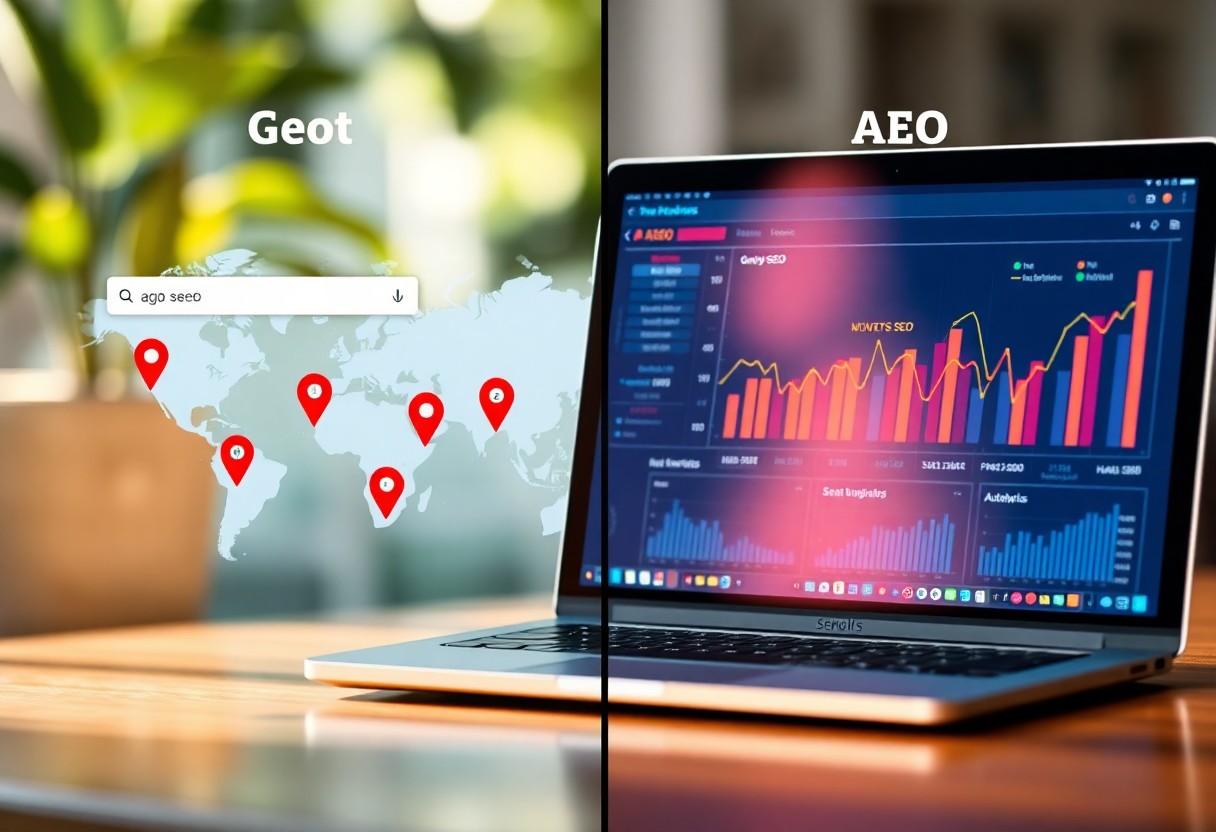
Over the digital landscape, I’ve uncovered a wild rivalry: Geo SEO and AEO. It’s not just about where you are; it’s about how algorithms weigh your presence online. If you think your website’s visibility is purely in your hands, think again! Algorithms can be your best friend or most dangerous foe, shaping your online traffic like a crafty magician. Let’s examine how you can leverage these forces to not only improve your rankings but also outsmart the competition.
Key Takeaways:
- Geo SEO focuses on optimizing content for local search results, improving visibility in geographic-specific queries.
- AEO (Algorithmic Experience Optimization) involves leveraging search engine algorithms to enhance user experiences and content relevance, impacting overall search performance.
- The interplay between local SEO strategies and algorithm-driven optimizations is vital for maximizing online visibility and attracting targeted audiences.
Geo SEO: Mapping Your Way to Success
As far as local visibility, Geo SEO is your compass, steering you toward relevant traffic and potential customers in your area. I’ve found that by optimizing your website and content with location-specific keywords and data, you can dominate search results for your local market. Think about including your city or neighborhood in titles, meta descriptions, and even within your content, as the right local strategies can significantly enhance your organic reach.
Navigating the Terrain of Local Search
Local search isn’t just for brick-and-mortar businesses; it’s a dynamic landscape influenced by your audience’s immediate needs. As I probe into this realm, I discover that using tools like Google My Business can elevate your visibility, ensuring that when someone searches for services in your vicinity, they find you at the top. Optimize your profiles with accurate information, engaging images, and customer reviews to make the most of this opportunity.
The Power of Proximity: Why Location Matters
Location isn’t just a dot on a map; it’s the heartbeat of your search strategy. I’ve learned that consumers are increasingly seeking services nearby, and search engines prioritize results based on geographic relevance. By focusing on local keywords and creating content that resonates with your community, you effectively narrow the competition and enhance your chances of conversion.
In fact, a study shows that 78% of mobile local searches result in an offline purchase, highlighting the impact of proximity on customer behavior. When you tailor your SEO efforts towards local intent, you tap into a stream of potential buyers who are actively seeking your products or services right around the corner. Understanding this actionable insight can help you align your business strategy with local demand, turning neighbors into loyal customers.
AEO: The Algorithmic Odyssey
AEO, or Algorithmic Experience Optimization, defines a new frontier in SEO where ‘user experience’ dictates algorithms rather than mere keyword stuffing. In my observations, search engines are constantly evolving, favoring sites that prioritize usability. This trend signifies that to capture audience attention, it’s vital to provide seamless navigation, speed, and optimal content tailored to user intent. You might find that a site’s bounce rate is often inversely proportional to its ranking on SERPs, proving that engagement matters more than ever.
Decoding the Digital Decision Makers
The algorithms behind search engines are like a tightly guarded recipe, constantly tweaked to enhance user satisfaction. These algorithms prioritize content relevance, trustworthiness, and engagement metrics. If I were you, I’d focus on optimizing for featured snippets and voice search, as these are becoming much sought-after real estate in SERPs, fundamentally altering how visibility is achieved.
How Algorithms Shape Visibility in the Online Jungle
Your journey through the online jungle of algorithms can feel daunting, but understanding their mechanics is liberating. Algorithms determine how your content is indexed and ranked based on a multitude of factors including relevance, user behavior, and historical data. I often analyze my site’s performance metrics, discovering that factors like page load speed and click-through rates influence my visibility. Targeting long-tail keywords and optimizing snippets can significantly enhance your chances of standing out in today’s competitive digital landscape.
Diving deeper into how algorithms shape visibility uncovers the intricate balance they maintain. For instance, Google’s search algorithm incorporates over 200 ranking signals, such as mobile-friendliness, incoming links, and social signals. By conducting regular site audits, I ensure I stay aligned with these fluctuating metrics. Strategies like A/B testing for content can reveal what resonates best with your audience, ultimately elevating your site’s ranking without sacrificing quality. This proactive approach proves that adapting to algorithmic shifts is vital for sustaining long-term search visibility.
The Tug of War: Geo SEO vs. AEO
The battle between Geo SEO and AEO exemplifies the tension between nurturing local connections and appeasing algorithmic demands. Each has its strengths, but in this digital tug-of-war, brands must navigate both landscapes to maximize visibility. While Geo SEO hones in on location-based strategies, AEO insists on a seamless user experience. The real challenge lies in determining which approach is best suited for your unique objectives and audience.
Battlegrounds: Where Location Meets Logic
I’ve found that the competition is most fierce in marketplaces where geography collides with digital activity. Local businesses seek to leverage Geo SEO to dominate their neighborhoods, whereas tech giants employ AEO to optimize for a global audience. For instance, a coffee shop might prioritize local keywords, while a streaming service focuses on user engagement metrics. The outcome of this clash will often dictate who captures the attention of searchers.
Finding the Balance: Strategies for Success
To excel in this arena, I recommend blending the techniques of both Geo SEO and AEO. Focus on localized content that resonates with your audience while ensuring that user experience remains top-notch. Consider using Google My Business to enhance local visibility and leverage AEO tactics such as optimizing page speed and improving mobile-friendliness to keep engagement high.
Expanding on this approach, I suggest utilizing a local schema markup to better communicate your business hours, address, and reviews, enhancing Geo SEO. Simultaneously, keep a close eye on analytics to identify user behavior patterns, allowing you to make data-driven AEO adjustments. For example, if you notice a high bounce rate on a specific page, you can tweak content both for local relevance and to enhance the overall user experience. Ultimately, blending these strategies leads to a holistic visibility approach that caters to your audience’s needs on all fronts.
The Future of Search Visibility: Trends to Watch
Voice Search Optimization
With voice search growing exponentially, I find that optimizing for it is no longer optional. By 2024, up to 50% of all searches could be voice-based. This shift demands that you focus on conversational keywords and natural language to capture those spoken queries effectively. Imagine your business being the go-to answer for a voice-activated device-it’s possible if you play your cards right.
AI and Machine Learning
AI’s impact on search algorithms is profound; according to recent trends, algorithms are getting smarter at understanding user intent. I’m constantly adjusting to ensure that semantic search is prioritized in my strategies. Utilizing AI tools can help streamline this process, leading to more personalized experiences for users and, consequently, improved search visibility.
Mobile-First Indexing
Mobile-first indexing is taking the spotlight, with Google prioritizing mobile-friendly sites. You should evaluate your website’s mobile experience-if it’s slow, clunky, or unresponsive, you’re likely falling behind. Research shows that over 60% of searches are now performed on mobile devices. If you’re not optimizing for this, you’re importantly shouting into the void.
To wrap up
Summing up, navigating the playground of Geo SEO and AEO is like perfecting a dance. You’ve got to know your rhythm-whether it’s local search quirks or complex algorithms. Each has its own flair that can impact your visibility, so staying savvy on both fronts will keep you ahead of the game. So, if you’re looking to shine in search engines, blend those location vibes with algorithmic finesse, and you’ll be strutting your stuff in no time.
FAQ
Q: What is Geo SEO?
A: Geo SEO refers to the practice of optimizing a website or online content to rank higher in search results based on geographic location. This includes factors like local keywords, Google My Business listings, and location-specific content.
Q: What is AEO?
A: AEO, or Answer Engine Optimization, focuses on optimizing content to be featured in search engine answer boxes or snippets. It involves structuring information clearly to satisfy user queries directly from searches.
Q: How do location factors impact Geo SEO?
A: Location factors impact Geo SEO by influencing search algorithm results that prioritize local relevance. Search engines consider user location when delivering results, making local backlinks and regional keywords vital for improved visibility.
Q: What role do algorithms play in AEO?
A: Algorithms play a significant role in AEO by determining which content is presented as answer boxes or snippets. Factors like content clarity, relevance, and structured data influence how effectively content is indexed and displayed in response to user queries.
Q: How can businesses optimize for both Geo SEO and AEO?
A: Businesses can optimize for both by creating location-specific content that answers common questions in their field. Using local keywords within well-structured HTML, optimizing for mobile, and utilizing schema markup enhance visibility for both Geo SEO and AEO efforts.